CineMatch
Kafka to Spark streaming to time-decayed ALS re-ranking, served as personalised top-10s in under 5 ms.
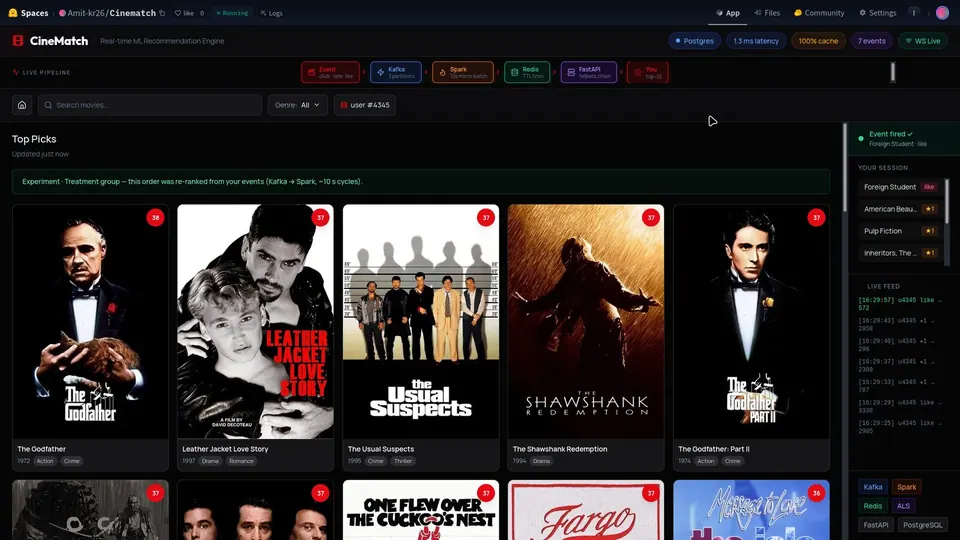
What it is
What it does
CineMatch serves personalised movie top-10s under 5 ms from a genuine streaming stack: clickstream events land in Kafka, Spark Structured Streaming re-ranks ALS candidates with time-decayed preference vectors every 10 seconds, and FastAPI pushes refreshed lists to a React dashboard over WebSockets. Four serving fallbacks mean the page is never blank.
Why it exists
I've watched batch recommenders serve yesterday's taste at lunch and go blank the second Redis hiccups. I wanted to see a click turn into a re-ranked top-10 within seconds, with fallbacks that keep the page alive and an A/B test that measures the real serving path, not a UI toggle.
Repo Amit-kr26/CinematchDemo huggingface.co/spaces/Amit-kr26/CinematchStack Python · Kafka · Spark · Redis · PostgreSQL · FastAPI · React · Docker
Lite single-container build on a free Hugging Face Space, so it needs a minute to boot. The full 10-service stack runs locally via docker-compose.
How it is built
Streaming spine
Kafka 3.9 in KRaft mode (3 partitions, no Zookeeper) ingests browser and simulator events; Spark Structured Streaming consumes 10-second micro-batches and routes invalid events to a dead-letter queue inspectable at GET /events/dlq.
ALS backbone
ALS (rank=50, regParam=0.1) trains on MovieLens 1M with leave-one-out evaluation; item factors, top-100 candidates per user and exposure-damped popularity are seeded into Redis, with NDCG@10 / Precision@10 logged to MLflow.
Time-decay scoring
Each event weighs exp(−0.001 · age_s) × type weight (click 1.0, view 1.5, like 2.5, rating 3.0) × rating strength; the L2-normalised preference vector is dotted against item factors plus a 0.15 genre-overlap bonus.
Diversity guard
From the fourth title of a primary genre, scores scale by 0.7^(c−2) (boosted for positives, damped for negatives) so recommendation lists don't collapse into a single genre.
Four-layer fallback
Redis re-ranked cache (TTL ~5 min) → PostgreSQL user_recs (treatment-only, skipped past 30 min staleness) → static ALS candidates → global popularity. Sub-2 ms hits at every layer; no blank page possible.
Serving-path A/B test
Deterministic hash bucketing where assignment genuinely gates serving: control users read the static ALS key, treatment users get event-re-ranked lists, and impressions and engagements stream into GET /stats/ab CTR.
Hot reload + observability
The streaming job polls model:version every ~10 minutes and swaps item factors in place without restart; Prometheus exposes latency histograms, cache-hit counters and DLQ depth beside Grafana boards.
How the pieces connect
Drawing is wider than the frame. Drag to pan.
Also filed under Data Engineering