Brain Tumor Segmentation Benchmark
Seven U-Net-family architectures trained head-to-head on BraTS2020 MRI slices, with Dice scores compared fairly.
What it is
What it does
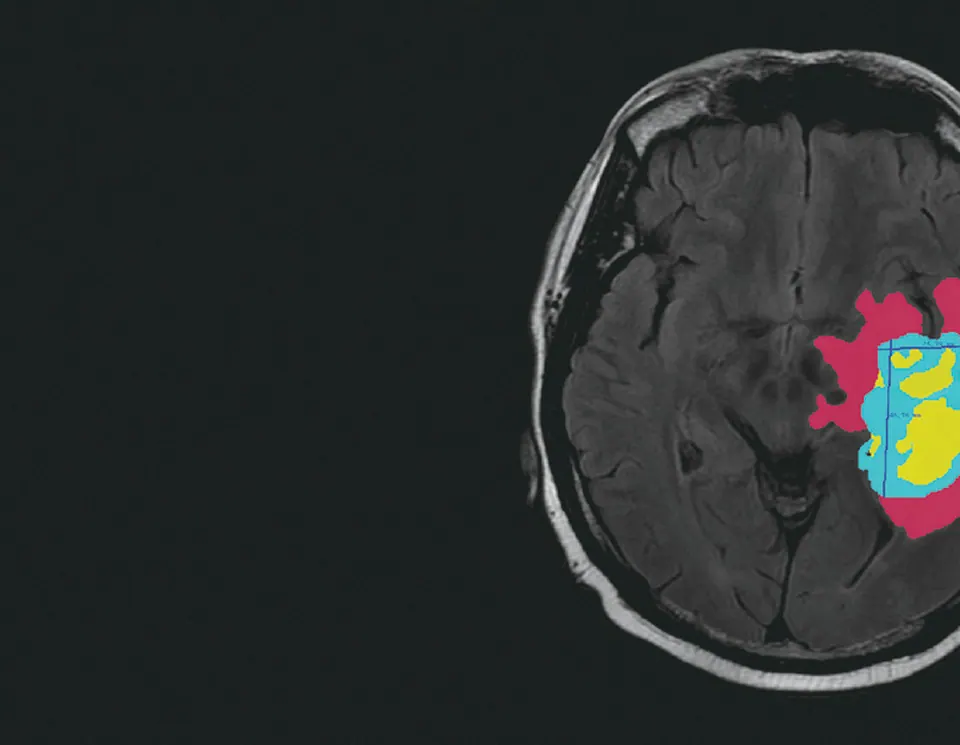
A controlled comparison: seven encoder-decoder segmentation networks built from scratch in Keras and trained on identically preprocessed BraTS2020 slices (UNet, CA-CNN, VNet, Attention U-Net, an nnUNet-style variant, a residual-block UNETR-style design and NNFormer), evaluated on Dice, IoU, sensitivity and specificity with per-class breakdowns for necrotic core, edema and enhancing tumour.
Why it exists
Every paper claimed state-of-the-art but trained on different slices, losses, and splits. I wanted one bar: same 368 volumes, same preprocessing, same metrics. So when UNet beats Attention U-Net, it's the architecture, not the setup.
Repo Amit-kr26/Multimodal-Deep-Learning-Approach-for-Brain-Tumor-SegmentationStack TensorFlow · Keras · UNet · Attention U-Net · UNETR · NNFormer · BraTS2020
How it is built
Identical data pipeline
A custom DataGenerator stacks FLAIR/T1/T1ce/T2 as four channels into 240×240 inputs, extracting 100 slices per volume starting at slice 22, with Gaussian blur + Otsu cropping; 368 patients split 312 train / 56 test (seed 42).
Seven builders, one compile
Every model compiles with Adam(lr=0.001) and categorical cross-entropy, sharing MeanIoU, dice, precision, sensitivity, specificity and three per-class Dice coefficients as metrics.
Distinctive architectures
CA-CNN adds anisotropic (3,1)/(1,3) convolutions; VNet decodes with Conv2DTranspose from 16 filters; Attention U-Net implements its own sigmoid attention gate on skips; the UNETR-style net threads residual blocks with 1×1 projection shortcuts.
Headline results
NNFormer reached ≈0.97 global Dice and the UNETR-style model 0.95 after five epochs (~2.85 h/epoch); ReduceLROnPlateau (factor 0.2, patience 2) managed every run.
Review-ready outputs
Inference exports per-class segmentation overlays to multi-page PDFs and animates prediction slices into GIFs for quick qualitative inspection.
How the pieces connect
Drawing is wider than the frame. Drag to pan.
Also filed under ML / DL